
Success in life isn’t determined by intelligence alone. While academic achievement and technical skills remain important, research consistently shows that the ability to understand and manage emotions plays a vital role in personal wellbeing, healthy relationships, leadership, and professional success.
This ability is known as Emotional Intelligence (EQ).
Whether you’re a parent, educator, healthcare professional, manager, or simply someone looking to improve your emotional wellbeing, developing emotional intelligence can transform the way you think, communicate, and respond to life’s challenges.
In this comprehensive guide, we’ll explore what emotional intelligence is, why it matters, the science behind it, and practical ways to strengthen your EQ every day.
What Is Emotional Intelligence?
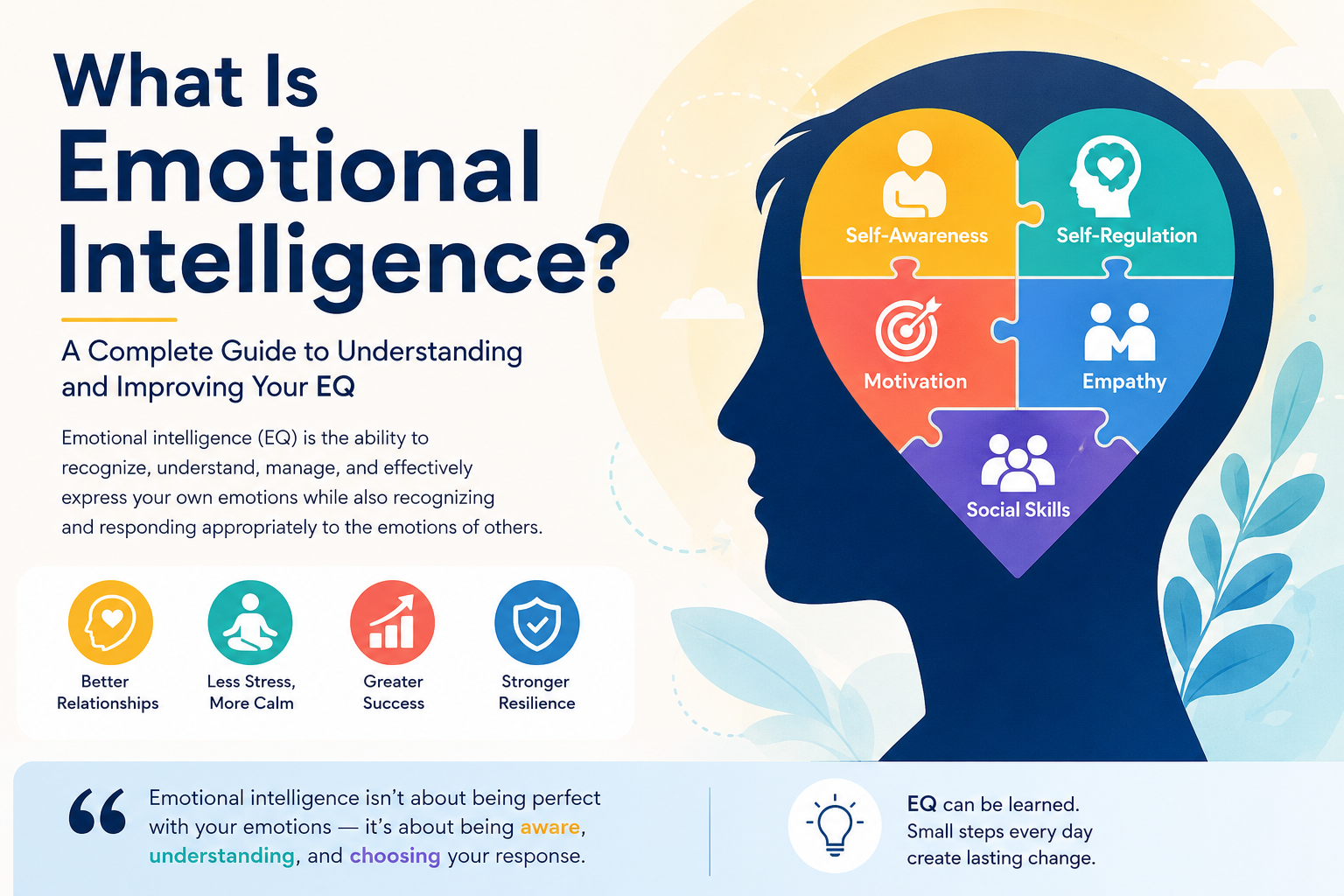
Emotional Intelligence (EQ) refers to the ability to recognize, understand, manage, and effectively express your own emotions while also recognizing and responding appropriately to the emotions of others.
Unlike IQ, which measures cognitive ability, emotional intelligence focuses on how people navigate emotions in everyday situations.
People with high emotional intelligence can:
- Stay calm under pressure.
- Handle conflict constructively.
- Build healthy relationships.
- Make thoughtful decisions.
- Show empathy.
- Adapt to change.
- Communicate effectively.
- Recover from setbacks more quickly.
The encouraging news is that emotional intelligence isn’t fixed. It can be developed throughout life through awareness, reflection, and consistent practice.
Why Is Emotional Intelligence Important?
Emotions influence every decision we make, often more than we realize.
People with stronger emotional intelligence tend to experience:
- Better mental health
- Healthier relationships
- Improved leadership abilities
- Higher workplace performance
- Greater resilience
- Better stress management
- Increased self-confidence
- More effective communication
Studies have linked emotional intelligence with greater life satisfaction, stronger teamwork, and improved psychological wellbeing.
The Five Components of Emotional Intelligence
Psychologist Daniel Goleman popularized five key elements of emotional intelligence that continue to guide emotional development today.
1. Self-Awareness
Self-awareness is the foundation of emotional intelligence.
It involves recognizing:
- What you’re feeling
- Why you’re feeling it
- How emotions influence your thoughts
- How emotions affect your behaviour
Someone with strong self-awareness notices emotional changes before reacting impulsively.
Example
Instead of saying:
“I’m angry.”
A self-aware person might think:
“I’m frustrated because I feel ignored during this meeting.”
This deeper understanding allows healthier responses.
2. Self-Regulation
Self-regulation means managing emotions rather than being controlled by them.
It doesn’t mean suppressing emotions.
Instead, it involves:
- Pausing before reacting
- Managing impulses
- Responding thoughtfully
- Remaining flexible during challenges
Healthy emotional regulation helps reduce conflict and improve decision-making.
3. Motivation
Emotionally intelligent people are often driven by internal motivation rather than external rewards.
They:
- Set meaningful goals
- Stay committed during setbacks
- Learn from mistakes
- Maintain optimism
- Focus on long-term growth
Intrinsic motivation supports resilience and continuous improvement.
4. Empathy
Empathy is the ability to understand another person’s emotional experience without immediately judging or trying to fix it.
Empathy involves:
- Active listening
- Curiosity
- Compassion
- Respect for different perspectives
Empathy strengthens families, friendships, schools, workplaces, and communities.
5. Social Skills
Emotional intelligence also includes the ability to build and maintain positive relationships.
Strong social skills include:
- Clear communication
- Healthy conflict resolution
- Collaboration
- Leadership
- Building trust
- Giving constructive feedback
These abilities help people create stronger personal and professional connections.
Emotional Intelligence vs IQ
Many people assume intelligence alone predicts success.
In reality, IQ and EQ complement each other.
| IQ | EQ |
|---|---|
| Measures reasoning ability | Measures emotional skills |
| Relatively stable | Can improve throughout life |
| Solves logical problems | Solves interpersonal problems |
| Academic performance | Relationship and leadership success |
| Technical knowledge | Emotional awareness |
Both forms of intelligence matter, but emotional intelligence often determines how effectively knowledge is applied in real life.
Signs of High Emotional Intelligence
You may have strong emotional intelligence if you:
- Recognize your emotions quickly.
- Accept constructive criticism.
- Stay calm during disagreements.
- Listen without interrupting.
- Admit mistakes.
- Respect others’ boundaries.
- Adapt to unexpected changes.
- Express emotions clearly.
- Support others without judgment.
- Learn from emotional experiences.
Signs Emotional Intelligence May Need Development
Everyone has room to grow.
Common indicators include:
- Frequent emotional outbursts
- Difficulty accepting feedback
- Blaming others
- Poor listening habits
- Constant conflict
- Trouble managing stress
- Avoiding difficult conversations
- Impulsive decisions
- Low empathy
- Difficulty understanding personal emotions
Recognizing these patterns is the first step toward meaningful change.
Can Emotional Intelligence Be Learned?
Absolutely.
Research shows emotional intelligence develops through intentional practice.
The brain remains capable of forming new emotional habits throughout adulthood, a process known as neuroplasticity.
With guidance, coaching, therapy, and self-reflection, people can significantly strengthen emotional skills over time.
Practical Ways to Improve Emotional Intelligence
Practice Emotional Check-Ins
Several times each day, ask yourself:
- What am I feeling?
- What triggered this emotion?
- What do I need right now?
Naming emotions accurately increases emotional awareness.
Expand Your Emotional Vocabulary
Instead of saying:
“I feel bad.”
Try identifying more specific emotions:
- Disappointed
- Frustrated
- Nervous
- Overwhelmed
- Lonely
- Hopeful
- Grateful
- Curious
The more precisely you identify emotions, the easier they become to manage.
Pause Before Reacting
When emotions rise:
- Take a deep breath.
- Count slowly.
- Delay responding.
- Consider your long-term goal.
Creating even a brief pause helps prevent impulsive reactions.
Practice Active Listening
Rather than preparing your response while someone else is speaking:
- Listen fully.
- Ask clarifying questions.
- Reflect back what you heard.
- Validate emotions without necessarily agreeing.
Feeling understood builds stronger relationships.
Develop Self-Compassion
Many people show kindness to others while criticizing themselves harshly.
Self-compassion involves:
- Accepting imperfections
- Learning from mistakes
- Speaking to yourself respectfully
- Reducing unnecessary self-judgment
This creates emotional resilience over time.
Keep an Emotion Journal
Writing regularly helps identify patterns.
Consider recording:
- Significant emotional moments
- Triggers
- Physical sensations
- Thoughts
- Behaviour
- Lessons learned
Journaling increases emotional awareness and supports personal growth.
Learn Healthy Stress Management
Managing stress improves emotional regulation.
Helpful strategies include:
- Exercise
- Mindfulness
- Deep breathing
- Quality sleep
- Healthy nutrition
- Time in nature
- Meaningful social connections
Small daily habits make a significant difference.
Emotional Intelligence in Children
Children begin developing emotional intelligence from an early age.
Parents and educators can help by:
- Naming emotions.
- Validating feelings.
- Teaching problem-solving.
- Modeling healthy emotional behaviour.
- Encouraging empathy.
- Reading stories that discuss emotions.
- Practicing calm communication.
Children learn emotional skills by observing trusted adults.
Emotional Intelligence in the Workplace
Organizations increasingly recognize emotional intelligence as a critical leadership skill.
Employees with strong EQ often:
- Communicate more effectively.
- Collaborate successfully.
- Adapt to change.
- Resolve conflict professionally.
- Inspire trust.
- Lead with empathy.
Workplaces that value emotional intelligence typically experience stronger engagement and healthier organizational culture.
Emotional Intelligence and Mental Wellbeing
Emotional intelligence is not a substitute for professional mental healthcare, but it can support emotional wellbeing.
People with higher EQ often experience:
- Better coping strategies
- Reduced emotional reactivity
- Greater resilience
- Improved relationships
- Healthier communication
- Better stress management
When emotional difficulties become overwhelming, working with a qualified mental health professional can provide valuable support.
Common Myths About Emotional Intelligence
Myth 1: Emotionally intelligent people never get angry.
False.
Everyone experiences difficult emotions.
The difference lies in how those emotions are understood and expressed.
Myth 2: Emotional intelligence means being nice all the time.
False.
Emotionally intelligent people can set healthy boundaries and have difficult conversations respectfully.
Myth 3: EQ is something you’re born with.
False.
Emotional intelligence develops throughout life.
Myth 4: Emotional intelligence replaces intelligence.
False.
Both IQ and EQ contribute to success.
Together, they support balanced decision-making.
Final Thoughts
Emotional intelligence is one of the most valuable life skills we can develop.
By becoming more aware of our emotions, learning to regulate our reactions, understanding others with empathy, and communicating effectively, we create stronger relationships, healthier workplaces, and greater personal wellbeing.
Like any skill, emotional intelligence grows through consistent practice—not perfection. Small daily improvements can lead to meaningful, lasting change over time.
Whether you’re supporting a child, leading a team, strengthening your relationships, or focusing on your own wellbeing, investing in emotional intelligence is an investment in a healthier, more connected future.
Frequently Asked Questions (FAQs)
What is emotional intelligence in simple terms?
Emotional intelligence is the ability to understand your own emotions, manage them effectively, recognize how others feel, and build healthy relationships.
Can emotional intelligence be improved?
Yes. Emotional intelligence can be developed through self-awareness, reflection, communication skills, emotional regulation, coaching, and therapeutic approaches such as Cognitive Behavioural Therapy (CBT).
Why is emotional intelligence important at work?
Employees with strong emotional intelligence communicate better, collaborate effectively, manage stress, resolve conflicts constructively, and often become stronger leaders.
Is emotional intelligence more important than IQ?
Both are valuable. IQ helps solve technical and analytical problems, while emotional intelligence supports decision-making, relationships, leadership, resilience, and overall wellbeing.
How long does it take to improve emotional intelligence?
Improvement varies from person to person, but many people notice positive changes within weeks or months of consistent practice.